
Key Takeaways
- Service pricing is based on device count and total SMS sent through the gateway. You need a working Android phone with a SIM and SMS credit from your mobile operator. Operator message costs are yours—we do not sell carrier SMS balance.
- The breaking decision is devices + login SLA + whether you can keep phones online — not a fake per-message platform rate.
- Free and Developer pause at published SMS caps. Starter / Professional / Business uncap platform send volume; devices still meter.
- Aggregator per-message plus rented numbers wins when you cannot hold SIMs or need alphanumeric IDs we do not sell.
- Starter / Professional / Business uncap platform send volume; operator airtime is never unlimited.
Android sms gateway pricing decision framework is when the SIM path stops being a clever experiment and starts being the wrong bill — or the right one. Plans are billed as device + SMS volume tiers—not aggregator-style $0.0x-per-message platform charging. Starter, Professional, and Business include unlimited platform send volume; Developer and Free have published SMS caps. Operator airtime remains separate, and carrier fair-use still applies.
Catalog: pricing. Contrast: vs Twilio-style APIs. You bring phones and operator credit.
Two meters
Platform devices + volume
Operator airtime
Two bills, always
Platform fee (devices + send volume) and carrier load. Mixing them in one spreadsheet is how “cheap OTP” turns into surprise prepaid burn. Industry A2P context: GSMA— not a price list.
If you cannot name who pays when the SIM is empty, you do not have a pricing model. You have a demo.
Break points
| Signal | Stay on SIM gateway | Change something |
|---|---|---|
| OTP SLA | Dedicated charged phone, isolated SIM | Shared radio with campaigns; no spare |
| Device count | Fits plan cap | Need more pairing slots than the SKU |
| Volume | Airtime budgeted; OEM ceilings raised | Free/Developer allowance exhausted mid-month |
| Identity | Local MSISDN is a feature | Must have rented alphanumeric / long code we do not sell |
| Geography | Countries you will SIM | Long-tail destinations with no handset |
When Free or Developer snaps
Free: 300 SMS lifetime, 1 device. Developer: 50USD/year, 1 device, 25,000 SMS per year. On Free and Developer, sending pauses when you use the plan SMS allowance rather than silently billing aggregator-style overage. Upgrade or request a custom allowance to continue. Use them to prove DLR and pairing — not as the production OTP backbone.
When Starter is enough
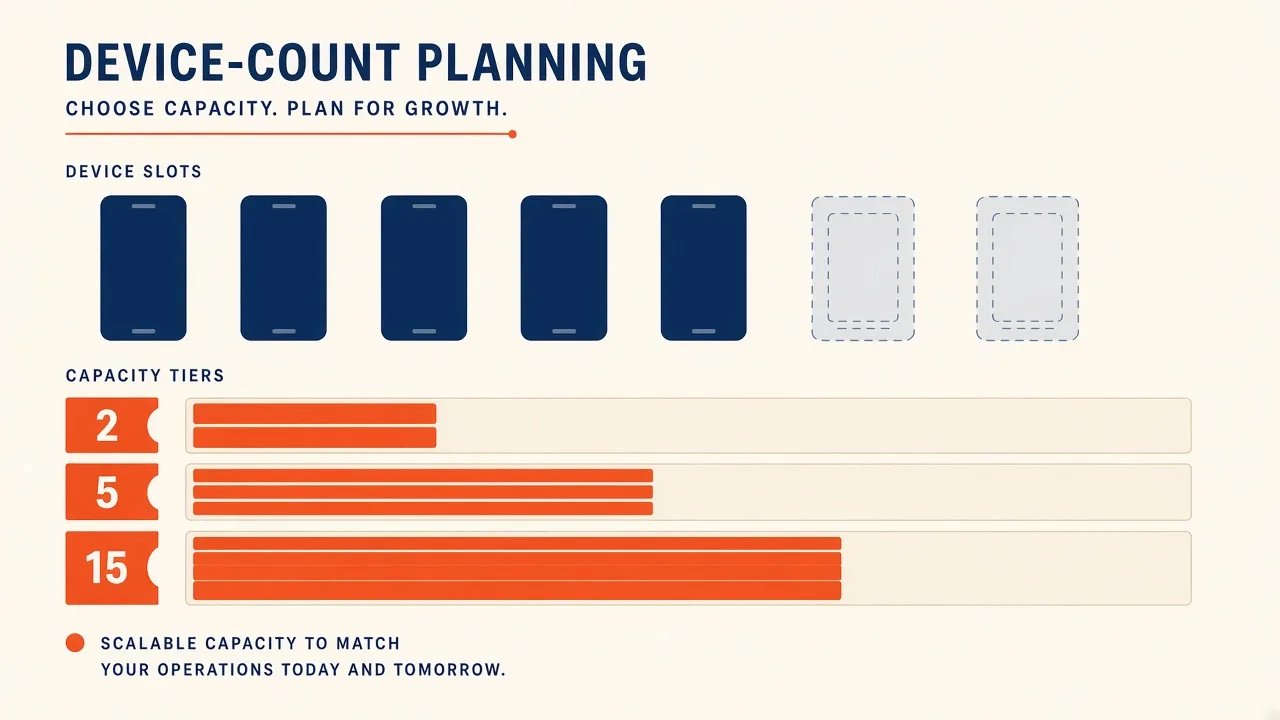
$19/month, 2 devices, platform send volume uncapped on that SKU. Operator airtime still yours. Fits a single OTP plant plus a spare, or OTP + light logistics.
When Pro / Business is the floor
Professional: $39/month, 5 devices. Business: $77/month, 15 devices. Buy these when the constraint is pairing slots and isolation (OTP / promo / country), not because a headline said unlimited carrier SMS.
On those three plans the pricing-card SMS row is platform send volume without a Developer-style cap. Carrier fair-use still applies.
When you still need a CPaaS
Rented numbers, alphanumeric headers, countries with no dock, or procurement that forbids handsets in a closet. Hybrid is allowed: Android for domestic OTP, aggregator for the long tail. How the gateway works.
Catalog numbers
Keep figures in sync with /pricing. White-label branding is contracted setup, not a turnkey “sell SMS” SKU.
Checklist
- Two-line budget: platform + operator.
- Device count includes hot spares.
- OTP isolated before you scale campaigns.
- Exit criteria for CPaaS hybrid written down.
Next steps
Map your actual phones to a SKU, then send a week of canary OTPs and read prepaid burn. Downloads · contact.
Related product pages
Jump to the live product docs for this topic—not another long-form article.
- device and SMS volume pricingPlans and allowances
- Android SMS gateway product guideDefinition, product, and how to buy
- SMS API documentationLive endpoint reference
- download the Android gateway appGet the APK