
Key Takeaways
- Android SMS gateway server scenario 264 is appointment OTP for card-on-file / deposit verification — not Saturday reviews (24), city queues (84), form packets (144), or waitlist fills (204).
- If the deposit code waits behind a review campaign, the chair is reserved on a card the client never confirmed.
- Priced by devices and SMS send volume. You use your own phone and operator SMS credit.
- Free is 300 SMS lifetime, 300 contacts, 1 device. Developer is 25,000 SMS per year.
- The gateway server must pin deposit OTP to a device token marketing jobs cannot use.
- Developer Center owns live API fields; this page is the deposit-hold failure map.
Summary
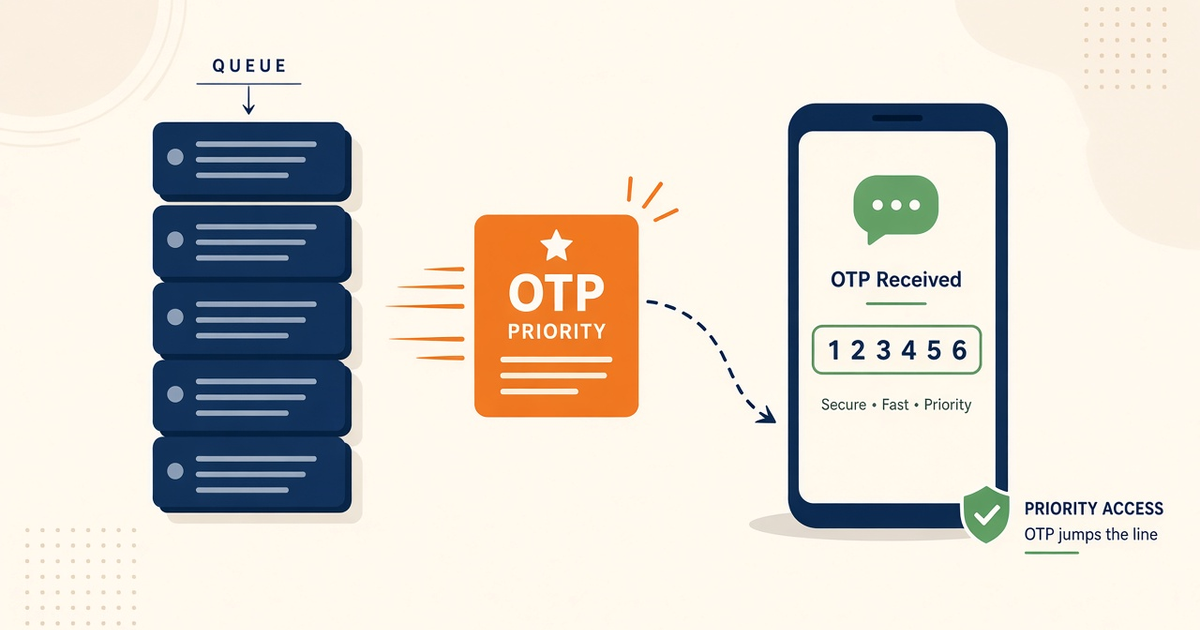
Android SMS gateway server scenario 264 is appointment businesses with an OTP priority queue for deposits: the control plane must not let review jobs steal the radio that authorizes a card hold. Service pricing is based on device count and total SMS sent through the gateway. You need a working Android phone with a SIM and SMS credit from your mobile operator. Operator message costs are yours—we do not sell carrier SMS balance.
A reserved chair on an unconfirmed card is not revenue. If P0 deposit OTP sat behind a review blast, you collected a complaint, not a hold.
Earlier appointment OTP pieces covered Saturday reviews, franchise queues, form packets, and waitlist races. This article stays on deposit authorization.
Key takeaways
- Android SMS gateway server scenario 264 is appointment OTP for card-on-file / deposit verification — not Saturday reviews (24), city queues (84), form packets (144), or waitlist fills (204).
- If the deposit code waits behind a review campaign, the chair is reserved on a card the client never confirmed.
- Priced by devices and SMS send volume. You use your own phone and operator SMS credit.
- Free is 300 SMS lifetime, 300 contacts, 1 device. Developer is 25,000 SMS per year.
- The gateway server must pin deposit OTP to a device token marketing jobs cannot use.
- Developer Center owns live API fields; this page is the deposit-hold failure map.
Related reading
Android SMS gateway server, OTP verification, transactional SMS, Developer Center.
Deposit-OTP context
High-no-show verticals ask for a card on file. The SMS code is the client’s yes. The server that also sends “how was your visit?” will bury that yes unless tokens are split.
Cross-link hub cornerstones. Confirm live request shapes in Developer Center.
Card-on-file codes first
Pin deposit OTP to a dedicated device connection. Marketing mailables must not reuse that Bearer. Cap resends; a failed hold should expire the reservation, not loop prepaid.
Write acceptance criteria: P3 cannot select the deposit IMEI, spare charged, staff canary on a fake hold.
Server ranks
| Rank | Traffic | Rule |
|---|---|---|
| P0 | Deposit / card-on-file OTP | Own server connection + SIM |
| P1 | Booking login OTP | After P0; still not promo |
| P2 | Reminders | Transactional; quiet hours |
| P3 | Reviews / openings | Never the deposit token |
Cost and ownership
Priced by devices and SMS send volume. You use your own phone and operator SMS credit. Developer is 25,000 SMS per year. A busy Saturday of holds is still devices + volume + airtime. Starter, Professional, and Business list Unlimited SMS as platform send volume; that is not unmetered carrier SMS.
A CodeCanyon booking clone is not this gateway and does not include operator credit.
Free 300 lifetime SMS is a pairing lab.
Operations
Daily: pairing, battery, deposit-queue age, review-queue isolation, DLR anomalies.
After OEM updates, re-canary a staff deposit OTP.
Name an on-call who can reach the deposit phone before first chair.
Security and compliance
Protect per-connection tokens. Never log full OTP bodies next to PAN fragments.
STOP applies to P3. Never auto-reply into deposit OTP. Verify webhook signatures on hold-confirm callbacks.
Decision guide
Ship android sms gateway server scenario 264 when marketing cannot use the deposit token. Delay if one Bearer sends everything.
If zero phone ops is mandatory, evaluate CPaaS for deposit OTP.
Checklist
- Dedicated deposit connection.
- P3 cannot select that IMEI.
- Resend caps + reservation expiry.
- Spare charged.
- Fake-hold canary.
- Developer Center checked.
- Airtime includes hold retries.
- On-call named.
Next steps
Return to server guide, compare device and SMS volume pricing, open device setup guide, and confirm APIs in SMS API documentation.
Deep dive: production hardening
Deposit-OTP hardening is a token ritual. If a contractor pastes the deposit Bearer into a review mailable, isolation is gone.
Battery exemptions and OEM killers still win overnight before Saturday holds.
Spare charged devices beat brochure SLAs. Airtime surprise bills happen when review CSVs ignore radio pace.
Never claim unlimited free cloud SMS credits with no device or volume meter. Name an on-call owner before unattended reviews go live.
Canary on staff numbers before client deposit OTP. Cross-link Setup, Pricing, Developer Center.
Document who owns SIM top-ups. Webhook signature verification is non-negotiable.
Prefer honest latency over global SLA claims. If zero phone ops is mandatory, evaluate CPaaS.
OTP and marketing must stay on separate lanes. Contact lists need consent metadata.
Dual-SIM routing fails when slot maps drift after reboot. Multi-device failover only helps if spare phones stay charged and paired.
Scheduled reminders must not steal the P0 SIM during a hold window.
Deep dive: scaling and failure modes
Scale chairs by OTP phones, not by implying unmetered carrier SMS after a flat fee.
Holiday books are queue events. Pause P3 when P0 ages out.
Retry storms burn credit. Expire the reservation instead of infinite resend.
Multi-location books may need a phone per site. Still devices + volume.
Do not load-test against live cards. Use staff cohorts.
Raise OEM/Android SMS rate ceilings carefully. Carrier fair-use still applies.
Measure intent-to-handset for P0, not HTTP accept on the server.
A second deposit device is cheaper than a no-show you cannot charge.
Watch prepaid during two-way YES holds. Inbound is a different lane.
Document the token map where ops can find it. If only the vendor knows the pairing PIN, you do not have a queue.
Deep dive: integration discipline
Hold each Bearer on the gateway server, never in a booking iframe. Idempotent reservation IDs prevent duplicate deposit OTP. MCP, if used, wraps the same REST — it is not a second carrier.
Store gateway message IDs on the hold row. The desk should not grep the phone.
Confirm live parameters in Developer Center. Sample JSON is not the contract.
Prefer feature flags. Enable deposit SMS for one provider first.
Keep examples conceptual until Developer Center confirms live request shapes. Budget airtime for retries.
Radio reality still wins. Cross-link hub cornerstones instead of rewriting the product overview.
Isolate OTP from review blasts. Verify webhooks before customer traffic.
Scenario success needs owners for phones, SIMs, templates, and on-call. That is android sms gateway server scenario 264.
Related product pages
Jump to the live product docs for this topic—not another long-form article.
- OTP and 2FA SMS on AndroidAuthentication flows
- multi-device and dual SIM routingCapacity and failover
- SMS delivery reports (DLR)Delivery status tracking
- SMS API documentationLive endpoint reference