
Key Takeaways
- This Hub H spoke deepens cpaas vs android sms gateway around compliance burden.
- Link the cornerstone — do not rewrite the full overview: Twilio vs Android SMS Gateway.
- Android SIM path: BYO phone and operator airtime; service fees by devices + SMS volume.
- Compare total cost of ownership, not sticker price alone.
- Be fair about when the other option wins (global reach, zero phone ops, SMPP/modems).
- Confirm live Android gateway fields in Developer Center.
- Never chase piracy keywords for ranking; discuss security risk carefully.
This Hub H guide focuses on cpaas vs android sms gateway with a deep dive on compliance burden. Start from Twilio vs Android SMS Gateway so this spoke does not rewrite the full overview. On the Android SIM path, service pricing is devices + send volume (free tier 300 SMS lifetime; paid from $19/month); you supply phone and operator SMS credit — see device and SMS volume pricing.
Moving OTP to a handset does not delete A2P homework. It changes who holds the MSISDN and who wakes up when STOP cannot land.
USA, SMS gateway FAQ and definitions, SMS API documentation, GoHighLevel help.
Context
This comparison walks through generic CPaaS and an Android SIM gateway on compliance burden.
Android path: your phone, your operator airtime, service fees by devices and SMS volume.
Stay fair: state when generic CPaaS is the better fit, not only when the Android gateway wins.
Search intent here is commercial comparison. Stay factual, avoid hype, and separate carrier cost from software cost.
Cross-link open-source and API guides when the reader is still choosing architecture, not only a vendor.
Core comparison
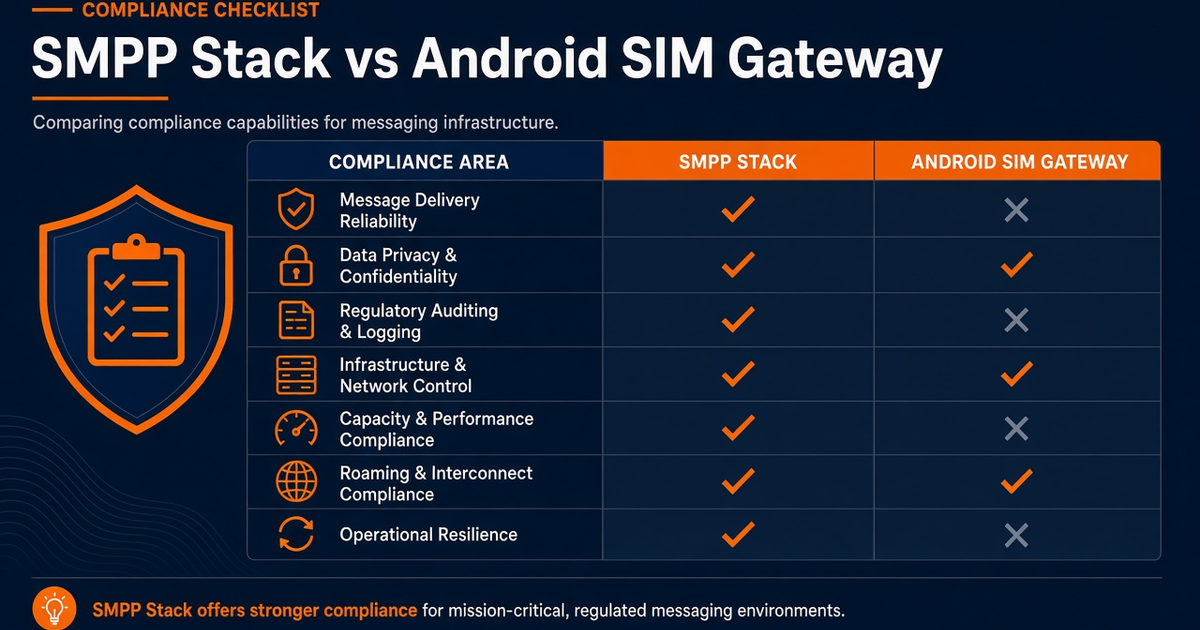
On compliance burden, map who owns numbers, who owns phones, and who owns overnight failures.
| Burden | Generic CPaaS | Android SIM gateway |
|---|---|---|
| CLI / identity | Rented numbers, vendor KYC | Your MSISDN, your SIM KYC |
| Content / STOP | Vendor + your templates | You + awake phone |
| Overnight | Vendor routes | OEM, charger, last-seen |
| SMS money | Per-message to vendor | Operator + device/volume fee |
Aggregator paths rent identity and bill per message. Android SIM paths use your SIM and operator plan.
Marketplace scripts add self-hosting: PHP panels, APKs, and author support windows.
Write the decision criteria before you watch another demo video.
Cost and ownership
Sticker price ignores hosting, engineer hours, OEM battery work, and airtime.
Devices + volume pricing is predictable when you know send rates; airtime remains variable by country.
One-time licenses can look cheaper until the first unpaid support weekend.
Model OTP and bulk separately so campaigns cannot surprise finance.
Operations
Phone power, pairing, and SIM top-ups dominate Android gateway uptime.
CPaaS ops shift toward account reputation, number inventory, and webhook reliability.
Script ops include panel upgrades and server patching you must staff.
Name an on-call owner before production traffic.
Security and compliance
Review auth defaults, secret storage, and update channels before purchase or cutover.
Do not run OTP on tampered or unlicensed builds.
STOP and consent rules still apply on promotional lanes.
Confirm webhook signatures and TLS everywhere credentials travel.
Decision guide
Choose based on compliance burden priorities: global reach, local SIM economics, or self-hosted control.
If you need zero phone ops and rented numbers, CPaaS is usually rational.
If you need local SIMs and BYO airtime with a maintained control plane, the Android SaaS path fits.
If you need deep forks and can staff ops, scripts or OSS may fit — with eyes open.
Checklist
- Cornerstone guide read for this hub.
- TCO model includes airtime and staff time.
- OTP vs marketing lanes separated.
- DLR/webhook story written down.
- Security/update channel verified.
- Fair note of when the other tool wins.
- Developer Center checked if adopting Android SaaS API.
- Migration facade planned if switching.
- On-call owner named.
- Canary plan before full cutover.
Next steps
Return to Twilio vs Android SMS Gateway, compare device and SMS volume pricing, and trial the Android path via download the Android gateway app when it fits. Keep API and open source guides nearby.
Deep dive: production hardening
Pricing models diverge: per-message + rented numbers versus devices + volume + operator airtime.
Confirm live Android gateway API fields in Developer Center. Comparison blogs are not endpoint catalogs.
OTP and marketing must stay on separate lanes regardless of vendor.
Spare charged devices matter more than brochure SLAs when phones send the SMS.
License domain rules on marketplace scripts can surprise multi-brand operators.
Demo OTP latency in a marketplace listing should be measured on a cold phone, not a warmed booth laptop.
Webhook signature verification is non-negotiable whether you buy a script or a SaaS control plane.
True cost includes engineer hours for OEM battery exemptions and SIM logistics.
When a comparison page and a blog spoke disagree, prefer the dedicated comparison product page for Twilio positioning.
Keep Hub G spokes linked to the CodeCanyon cornerstone so you do not rewrite the full buyer overview.
Keep Hub H spokes linked to the RBSoft alternatives guide and Twilio comparison page as appropriate.
Airtime surprise bills happen when bulk loops ignore radio pace — vendor choice does not remove that physics on SIM paths.
Document who owns the phone drawer before you declare an Android gateway production-ready.
Feature flags help ramp OTP after a vendor switch without a big-bang cutover.
Exit plans matter: export contacts, templates, and message history before you cancel anything.
Marketplace SMS scripts and aggregator APIs solve different problems than an Android SIM gateway. Compare total cost of ownership, not sticker price alone.
You still supply a working Android phone and operator SMS credit on the Android gateway path. Service pricing is device count plus SMS send volume.
CodeCanyon listings often bundle a PHP panel and APK. That is self-hosting work, not free carrier traffic.
Never optimize SEO for piracy terms. Discuss security and license risk without chasing those queries.
Aggregator networks rent numbers and bill per message. Android SIM gateways use your SIM and operator plan.
Deliverability is radio and carrier reality on the SIM path; it is network reputation on the CPaaS path. Do not pretend they are identical.
Developer experience includes docs freshness, DLR/webhooks, SDKs, and whether someone answers security mail.
Compliance burden includes STOP handling, consent, and regional rules — plus who owns the number identity.
Switching costs fall when your app talks to a narrow SMS interface you control, not vendor UI glue.
Fair comparisons state when the other tool wins: regulated long codes, global reach, or zero phone ops.
Support quality on one-time marketplace purchases is usually time-boxed. Maintained SaaS support is a product line.
Security review before buying a script should include auth defaults, update cadence, and SMS permission surface on the APK.
Migration off a marketplace script succeeds when message ids, templates, and device pairing are inventoried first.
RBSoft-class and Ozeki-class stacks may fit teams that want modem/SMPP-centric ops. Android phone gateways optimize for handset fleets.
Twilio-class CPaaS wins on global APIs and compliance tooling; Android gateways win on local SIM economics and BYO airtime.
Pricing models diverge: per-message + rented numbers versus devices + volume + operator airtime.
Confirm live Android gateway API fields in Developer Center. Comparison blogs are not endpoint catalogs.
OTP and marketing must stay on separate lanes regardless of vendor.
Spare charged devices matter more than brochure SLAs when phones send the SMS.
License domain rules on marketplace scripts can surprise multi-brand operators.
Demo OTP latency in a marketplace listing should be measured on a cold phone, not a warmed booth laptop.
Webhook signature verification is non-negotiable whether you buy a script or a SaaS control plane.
True cost includes engineer hours for OEM battery exemptions and SIM logistics.
When a comparison page and a blog spoke disagree, prefer the dedicated comparison product page for Twilio positioning.
Keep Hub G spokes linked to the CodeCanyon cornerstone so you do not rewrite the full buyer overview.
Keep Hub H spokes linked to the RBSoft alternatives guide and Twilio comparison page as appropriate.
Airtime surprise bills happen when bulk loops ignore radio pace — vendor choice does not remove that physics on SIM paths.
Deep dive: scaling and failure modes
Marketplace SMS scripts and aggregator APIs solve different problems than an Android SIM gateway. Compare total cost of ownership, not sticker price alone.
You still supply a working Android phone and operator SMS credit on the Android gateway path. Service pricing is device count plus SMS send volume.
CodeCanyon listings often bundle a PHP panel and APK. That is self-hosting work, not free carrier traffic.
Never optimize SEO for piracy terms. Discuss security and license risk without chasing those queries.
Aggregator networks rent numbers and bill per message. Android SIM gateways use your SIM and operator plan.
Deliverability is radio and carrier reality on the SIM path; it is network reputation on the CPaaS path. Do not pretend they are identical.
Developer experience includes docs freshness, DLR/webhooks, SDKs, and whether someone answers security mail.
Compliance burden includes STOP handling, consent, and regional rules — plus who owns the number identity.
Switching costs fall when your app talks to a narrow SMS interface you control, not vendor UI glue.
Fair comparisons state when the other tool wins: regulated long codes, global reach, or zero phone ops.
Support quality on one-time marketplace purchases is usually time-boxed. Maintained SaaS support is a product line.
Security review before buying a script should include auth defaults, update cadence, and SMS permission surface on the APK.
Migration off a marketplace script succeeds when message ids, templates, and device pairing are inventoried first.
RBSoft-class and Ozeki-class stacks may fit teams that want modem/SMPP-centric ops. Android phone gateways optimize for handset fleets.
Twilio-class CPaaS wins on global APIs and compliance tooling; Android gateways win on local SIM economics and BYO airtime.
Pricing models diverge: per-message + rented numbers versus devices + volume + operator airtime.
Confirm live Android gateway API fields in Developer Center. Comparison blogs are not endpoint catalogs.
OTP and marketing must stay on separate lanes regardless of vendor.
Spare charged devices matter more than brochure SLAs when phones send the SMS.
License domain rules on marketplace scripts can surprise multi-brand operators.
Demo OTP latency in a marketplace listing should be measured on a cold phone, not a warmed booth laptop.
Webhook signature verification is non-negotiable whether you buy a script or a SaaS control plane.
True cost includes engineer hours for OEM battery exemptions and SIM logistics.
When a comparison page and a blog spoke disagree, prefer the dedicated comparison product page for Twilio positioning.
Keep Hub G spokes linked to the CodeCanyon cornerstone so you do not rewrite the full buyer overview.
Keep Hub H spokes linked to the RBSoft alternatives guide and Twilio comparison page as appropriate.
Airtime surprise bills happen when bulk loops ignore radio pace — vendor choice does not remove that physics on SIM paths.
Document who owns the phone drawer before you declare an Android gateway production-ready.
Feature flags help ramp OTP after a vendor switch without a big-bang cutover.
Exit plans matter: export contacts, templates, and message history before you cancel anything.
Marketplace SMS scripts and aggregator APIs solve different problems than an Android SIM gateway. Compare total cost of ownership, not sticker price alone.
You still supply a working Android phone and operator SMS credit on the Android gateway path. Service pricing is device count plus SMS send volume.
CodeCanyon listings often bundle a PHP panel and APK. That is self-hosting work, not free carrier traffic.
Never optimize SEO for piracy terms. Discuss security and license risk without chasing those queries.
Aggregator networks rent numbers and bill per message. Android SIM gateways use your SIM and operator plan.
Deliverability is radio and carrier reality on the SIM path; it is network reputation on the CPaaS path. Do not pretend they are identical.
Developer experience includes docs freshness, DLR/webhooks, SDKs, and whether someone answers security mail.
Compliance burden includes STOP handling, consent, and regional rules — plus who owns the number identity.
Switching costs fall when your app talks to a narrow SMS interface you control, not vendor UI glue.
Fair comparisons state when the other tool wins: regulated long codes, global reach, or zero phone ops.
Support quality on one-time marketplace purchases is usually time-boxed. Maintained SaaS support is a product line.
Security review before buying a script should include auth defaults, update cadence, and SMS permission surface on the APK.
Deep dive: integration discipline
Deliverability is radio and carrier reality on the SIM path; it is network reputation on the CPaaS path. Do not pretend they are identical.
Developer experience includes docs freshness, DLR/webhooks, SDKs, and whether someone answers security mail.
Compliance burden includes STOP handling, consent, and regional rules — plus who owns the number identity.
Switching costs fall when your app talks to a narrow SMS interface you control, not vendor UI glue.
Fair comparisons state when the other tool wins: regulated long codes, global reach, or zero phone ops.
Support quality on one-time marketplace purchases is usually time-boxed. Maintained SaaS support is a product line.
Security review before buying a script should include auth defaults, update cadence, and SMS permission surface on the APK.
Migration off a marketplace script succeeds when message ids, templates, and device pairing are inventoried first.
RBSoft-class and Ozeki-class stacks may fit teams that want modem/SMPP-centric ops. Android phone gateways optimize for handset fleets.
Twilio-class CPaaS wins on global APIs and compliance tooling; Android gateways win on local SIM economics and BYO airtime.
Pricing models diverge: per-message + rented numbers versus devices + volume + operator airtime.
Confirm live Android gateway API fields in Developer Center. Comparison blogs are not endpoint catalogs.
OTP and marketing must stay on separate lanes regardless of vendor.
Spare charged devices matter more than brochure SLAs when phones send the SMS.
License domain rules on marketplace scripts can surprise multi-brand operators.
Demo OTP latency in a marketplace listing should be measured on a cold phone, not a warmed booth laptop.
Webhook signature verification is non-negotiable whether you buy a script or a SaaS control plane.
True cost includes engineer hours for OEM battery exemptions and SIM logistics.
When a comparison page and a blog spoke disagree, prefer the dedicated comparison product page for Twilio positioning.
Keep Hub G spokes linked to the CodeCanyon cornerstone so you do not rewrite the full buyer overview.
Keep Hub H spokes linked to the RBSoft alternatives guide and Twilio comparison page as appropriate.
Airtime surprise bills happen when bulk loops ignore radio pace — vendor choice does not remove that physics on SIM paths.
Document who owns the phone drawer before you declare an Android gateway production-ready.
Feature flags help ramp OTP after a vendor switch without a big-bang cutover.
Exit plans matter: export contacts, templates, and message history before you cancel anything.
Marketplace SMS scripts and aggregator APIs solve different problems than an Android SIM gateway. Compare total cost of ownership, not sticker price alone.
You still supply a working Android phone and operator SMS credit on the Android gateway path. Service pricing is device count plus SMS send volume.
CodeCanyon listings often bundle a PHP panel and APK. That is self-hosting work, not free carrier traffic.
Never optimize SEO for piracy terms. Discuss security and license risk without chasing those queries.
Aggregator networks rent numbers and bill per message. Android SIM gateways use your SIM and operator plan.
Deliverability is radio and carrier reality on the SIM path; it is network reputation on the CPaaS path. Do not pretend they are identical.
Developer experience includes docs freshness, DLR/webhooks, SDKs, and whether someone answers security mail.
Compliance burden includes STOP handling, consent, and regional rules — plus who owns the number identity.
Switching costs fall when your app talks to a narrow SMS interface you control, not vendor UI glue.
Fair comparisons state when the other tool wins: regulated long codes, global reach, or zero phone ops.
Support quality on one-time marketplace purchases is usually time-boxed. Maintained SaaS support is a product line.
Security review before buying a script should include auth defaults, update cadence, and SMS permission surface on the APK.
Migration off a marketplace script succeeds when message ids, templates, and device pairing are inventoried first.
RBSoft-class and Ozeki-class stacks may fit teams that want modem/SMPP-centric ops. Android phone gateways optimize for handset fleets.
Twilio-class CPaaS wins on global APIs and compliance tooling; Android gateways win on local SIM economics and BYO airtime.
Related product pages
Jump to the live product docs for this topic—not another long-form article.
- SMS API documentationLive endpoint reference
- device and SMS volume pricingPlans and allowances
- Twilio vs Android SMS gatewayCloud vs own-SIM cost model
- Security and Trust CenterCompliance and posture