
Key Takeaways
- Ozeki-style SMPP gateways and Android SIM gateways solve different ops problems — do not treat them as drop-in substitutes.
- SMPP assumes interconnects, Windows/Linux gateway software, and SMSC-facing operations.
- An Android SMS gateway assumes you host phones, SIMs, RF, and operator airtime; the control plane is HTTPS/JSON.
- Compare TCO: interconnect + staff + licenses vs devices + volume + carrier credit.
- We do not sell carrier SMS balance. Platform pricing is devices plus send volume.
Two different products
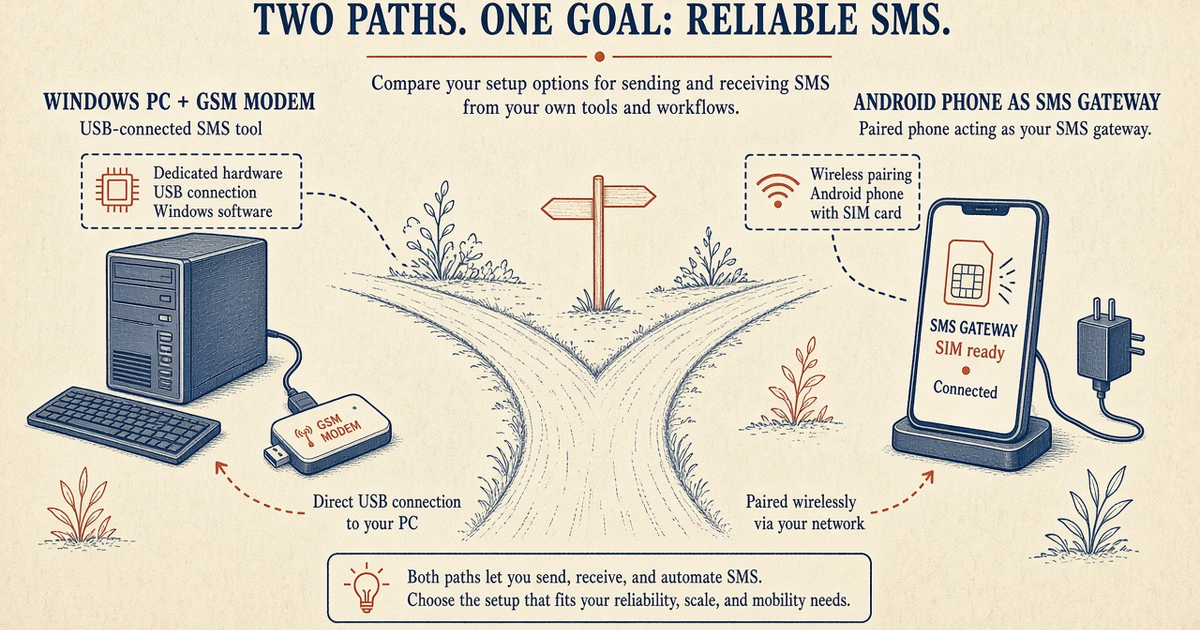
“Ozeki SMPP vs Android SMS gateway” is a category collision. Ozeki NG SMS Gateway and similar Windows/Linux SMPP stacks sit next to carrier interconnects and SMSC bindings. An Android SMS gateway sits next to a phone you own: HTTPS in, SIM out. Both move short messages. The staffing, failure modes, and invoices do not match.
SMS Gateway (this product) is the Android path: cloud control plane, official APK, your operator airtime. Product overview: how an Android SMS gateway works. Pricing: devices + SMS send volume. You bring the handset and carrier credit.
“If you need SMPP binds and SMSC ops, buy that stack. If you need POST JSON and a real MSISDN from a phone you unlock, buy the Android path. Mixing the marketing language is how RFPs go sideways.”
SMPP stack vs SIM radio
Side-by-side comparison
| Ozeki / SMPP gateway | Android SMS gateway | |
|---|---|---|
| Protocol to network | SMPP (and related) to SMSC / provider | Phone radio via your SIM |
| Your integration | Often SMPP, SQL, or vendor APIs | HTTPS JSON + Bearer token |
| Hardware you host | Servers (and maybe modems) | Android phones / tablets |
| From number | Whatever the bind allows | The MSISDN on your SIM |
| Typical staff | Windows/Linux + telecom ops | Device, OEM, airtime ops |
| Platform fee here | N/A (their license model) | Devices + SMS volume |
When SMPP / Ozeki fits
Choose an SMPP gateway when you already have interconnects, need high sustained throughput beyond handset radio ceilings, or your compliance team insists on SMSC-grade tooling. Vendor documentation for Ozeki lives on their site — evaluate it on its own terms (ozekisms.com). That stack is real; it is simply a different purchase.
When Android SIM fits
Choose Android when recipients should see your real mobile number, you already buy operator airtime, and a small team can keep phones charged and online. OTP, transactional alerts, and two-way threads on a known MSISDN are the sweet spot. Throughput scales with device count and carrier fair-use — not with a credit pack fantasy.
Cost models
Android path: plan meters devices and send volume; you pay the carrier for each segment the radio sends. Free is 300 SMS lifetime; Developer is 25,000 SMS per year; higher plans uncap platform volume while devices still meter. See pricing. SMPP path: licenses, hosting, and interconnect — none of which we refund as “unused SMS credits.”
Moving between them
Export consent flags and templates before you cut over. Do not dual-send OTP during migration. Canary on staff numbers. If you keep SMPP for bulk and Android for OTP, route explicitly in your app — two adapters, one decision tree.
Integration shape
Our side is REST. Samples: PHP, C#. Not a fake multi-language SDK product. Webhooks: webhook integration. Live fields: Developer Center.
Decision guide
- Need SMSC binds and zero phones → SMPP / Ozeki-class.
- Need real SIM MSISDN + HTTPS → Android SMS gateway.
- Need both → hybrid with explicit routing, not marketing mashups.
More category context: comparisons.
Next steps
Read product overview, setup, and API docs.
Related product pages
Jump to the live product docs for this topic—not another long-form article.
- device and SMS volume pricingPlans and allowances
- Twilio vs Android SMS gatewayCloud vs own-SIM cost model
- Android SMS gateway product guideDefinition, product, and how to buy
- SMS API documentationLive endpoint reference