
Key Takeaways
- SMSGate-class open source Android SMS gateways are DIY agents you host. Evaluate the repo in front of you — this spoke does not reprint any project’s README.
- Start from the cornerstone open-source guide; this page is the narrower “what that architecture implies.”
- You still pay the operator. License ≠ airtime.
- Score last commit, DLR/webhooks, OEM battery notes, and issue response — not star count.
- Priced by devices and SMS send volume. You use your own phone and operator SMS credit. Maintained path: free 300 SMS lifetime; paid from $19/month.
- USB modem/AT stacks are a different ops model. Do not mix them into the same requirement doc.
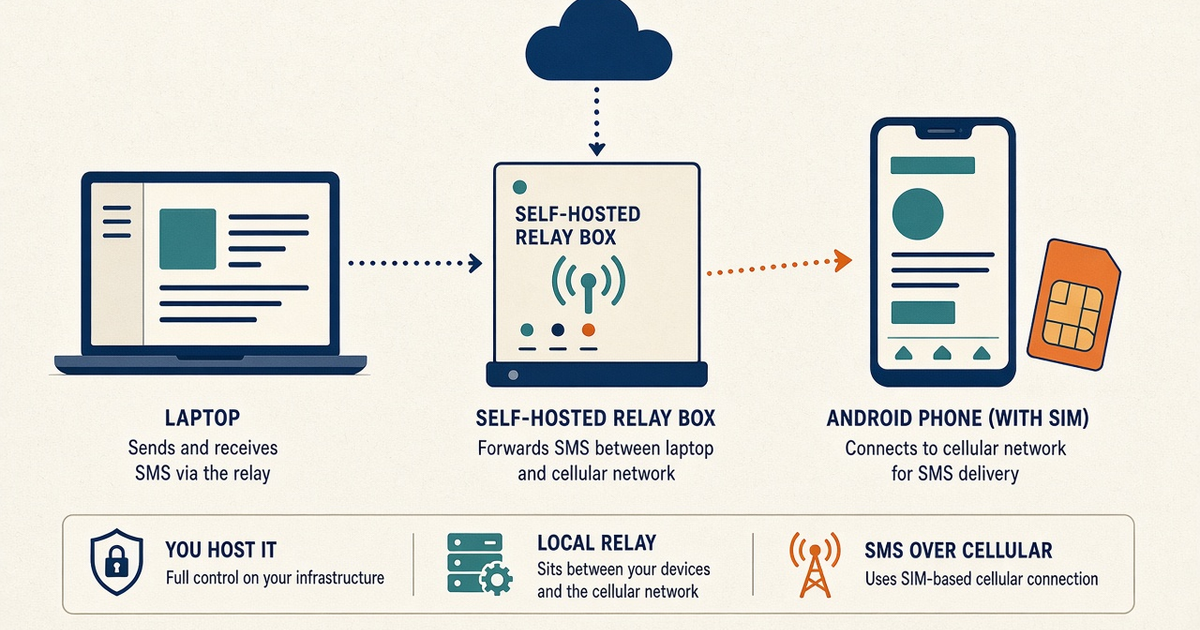
This Hub E spoke explains android sms gateway open source in the SMSGate-shaped architecture: an Android agent, a queue you run, a SIM you fund. Cornerstone: Android SMS gateway open source. OTP-shaped comparison: OSS for OTP verification. We do not vendor their trademark; we describe the class.
Priced by devices and SMS send volume. You use your own phone and operator SMS credit.
If the README’s last screenshot is from an Android version you cannot buy anymore, you did not find a gateway. You found an archive.
SMSGate as a class, not a SKU
Search results dump similarly named repos: some alive, some forks of forks. Your evaluation target is the tree you will actually deploy. This article stays at architecture so we are not mirroring copyrighted docs or pretending one GitHub URL is frozen forever.
Typical DIY shape: agent + something HTTP
Phone app talks to a server you host (or a port you opened on the LAN). Your backend posts JSON. The agent calls Android SMS APIs. Variants add MQTT, local-only mode, or a USB modem instead of a phone — the last is not the same ops model. Keep requirements split.
Evaluation table before you fork
| Signal | Healthy DIY | Walk away |
|---|---|---|
| Commits / releases | This year, changelog exists | Last APK is a mystery zip on a forum |
| DLR / inbound | Documented events you can verify | “TODO webhooks” |
| OEM battery | Named Xiaomi/Samsung notes | Silence — you will rediscover Doze at 2 a.m. |
| Auth | Tokens, TLS story | Open HTTP on 0.0.0.0 |
| License | You can comply in production | You cannot ship the fork legally |
GitHub stars are a popularity contest. OTP uptime is a closet of phones.
Ops you inherit with the zip file
Pairing, app updates vs Android updates, SIM airtime, spare handset, signature verification if you add webhooks. The runbook still exists. OSS just means you wrote more of it.
Local SIM still wins (example: Bangladesh)
DIY or maintained, domestic OTP/bulk wants a local MSISDN. Example country path: SMS gateway in Bangladesh. Same rule in every geo: operator credit is yours.
Exposed listeners and stale APKs
Sideloaded random “SMSGate” APKs from drive-by blogs are malware with extra steps. Prefer the project’s own signed artifacts. Do not paste API keys into issues. Rotate when people leave.
When this class is the right hammer
- You must compile and audit the agent.
- Lab, air-gap, or a single internal line with an engineer who likes Android internals.
- You already run the HTTP edge and accept on-call for it.
When a maintained control plane is cheaper
Production customer OTP, multi-device routing, and “we are not an Android shop.” Official APK: downloads. Catalog: device and SMS volume pricing. Samples (not a packaged SDK): PHP, C#.
Checklist
- Cornerstone OSS article read first.
- Specific repo scored on the table above.
- License compatible with how you deploy.
- TLS + auth on any listener.
- OEM keep-alive plan written.
- Operator credit budgeted.
- Facade if you might swap to maintained.
- No USB-modem requirements mixed in by accident.
- Staff canary on a real SIM.
- No “free SMS” claim from a software license.
Next steps
Return to the open-source hub, compare OTP needs in the OTP in-depth spoke, and keep airtime honest. The class is DIY. The SIM is still the last mile.
Related product pages
Jump to the live product docs for this topic—not another long-form article.
- SMS API documentationLive endpoint reference
- device and SMS volume pricingPlans and allowances
- Twilio vs Android SMS gatewayCloud vs own-SIM cost model
- Android SMS gateway product guideDefinition, product, and how to buy